Why measuring poverty using income is misleading and why we need to switch to using wealth
THE LAST WORD | ANDREW M. MWENDA | It is seven months since Uganda locked down due to COVID. The lesson I have learnt from the lockdown is not related to health but economics. It concerns the method we use to measure poverty (indirectly, wellbeing). Currently, the Uganda Bureau of Statistics (UBOS), like nearly all measurements of poverty elsewhere in the world, relies on income. COVID has taught us that income can sometimes be a misleading indicator of wellbeing.
To be accurate, UBOS believes that people are often unwilling to declare their income. So it uses people’s expenditure as a backdoor to understand their income i.e. the “mean consumption per capita.” This refers to a basket of goods and services someone needs to sustain a bearable lifestyle. UBOS believes people can be honest about how much they spend not how much they earn.
Now according to UBOS, the number of people living in poverty in Kampala District is only 2.6% and in the surrounding Wakiso District, 2.7%, making these two districts the richest (or the least poor). The districts with the largest percentage poor people are Kotido (73.4%) and Nabilatuk (73.1%). Ideally we should conclude from these poverty numbers that people from Kampala and Wakiso have the least precarious livelihoods in Uganda. Right?
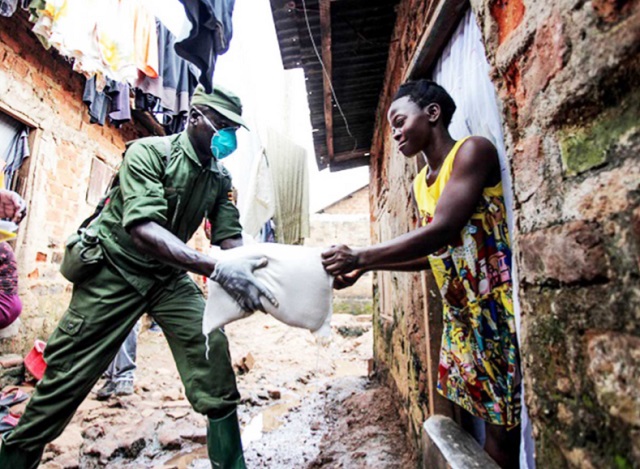
However, during the COVID lockdown, government distributed relief food in Kampala and Wakiso, not Kotido and Nabilatuk. Why? Why were the districts with the least number of poor people the ones that got relief food during COVID lockdown? Or was this a sign that government was politically pandering to the most articulate section of our society in Kampala and Wakiso while neglecting of the most vulnerable in Kotido and Nabilatuk?
Governments everywhere tend to fear urban constituencies. This is because being educated; urbanised and articulate, they have a higher ability to organise politically. Cities are centers of political gravity; so urban constituencies can threaten the security of governments, even dictatorial ones. Thus in cases of emergency, governments would be much more responsive to urban than rural demands. We cannot therefore remove this political calculation from the analytical arithmetic that caused government to distribute food in Kampala and Wakiso, and not in Kotido and Nabilatuk.
Yet even with this insight, I think the main reason government provided relief food in Kampala and not Kotido has much more to do with the precariousness of livelihoods than political calculation. I am inclined to believe that the more urbanised a place is the more precarious life would be for those at the bottom. This is because practically everything that sustains livelihoods of people in urban areas is secured through the intermediation of the market – they pay rent; buy food, water, energy for cooking, etc.
The post Lessons on poverty from COVID appeared first on The Independent Uganda:.
from The Independent Uganda: https://ift.tt/2IXwbQK


0 Comments