Analysts on how the former guerilla leader practices self-preservation after 35 years in power
Kampala, Uganda | IAN KATUSIIME | News this week of a coup in Guinea surprised many people not least its victim President Alpha Conde whose photos of him looking disheveled in a half buttoned shirt seated on a sofa surrounded by his AK47 wielding captors left many people pondering on what it actually means to “hold power” in African countries.
Conde’s story is not so different from the usual African strongman. He pushed ahead with a controversial third term last year in which Guineans were killed while protesting the maneuver. Conde did not have a military background but it was the usual playbook; consolidating power, muzzling the press, jailing opponents.
In the last few years, military coup d’états have been occurring with surprising frequency on the African continent. Mali, Central African Republic, Niger and Zimbabwe and in the not so recent past; closer home in Burundi.
Naturally the talk of whether a similar event can happen in Uganda gets underway whenever there are mutinous developments in other African countries.
In the Museveni era, Uganda has had its own coup whispers and it was hard to tell whether they were real or decoy actions. In March 2013, gunmen attacked Mbuya barracks at the army headquarters which sparked rumours of a suspected coup although they died out soon after.
In June 2016, there were clashes involving SFC, UPDF officers and police and other gunmen in different pockets of the country. Scores were arrested but they all looked like false flag operations. Those who carried out the arrests said the suspects were involved in subversive activities. That was the end of it.
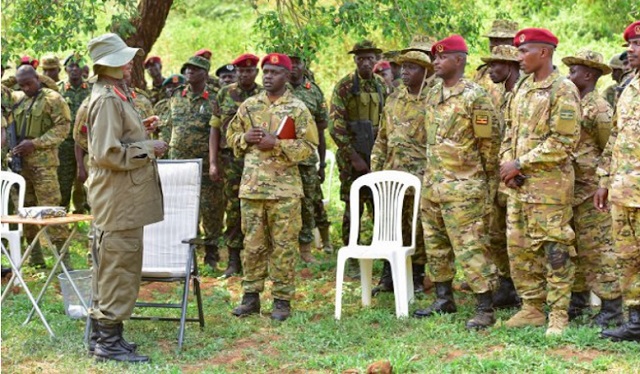
Supporters of President Yoweri who is in his 35th year in power says a military coup cannot happen because he wields unquestionable authority on the army; the Uganda Peoples Defence Forces (UPDF).
His regular reshuffles of the UPDF top brass create an aura of invincibility of around him. But Museveni’s age and the ever bubbling political tensions in the country appear to create vulnerabilities around the power structures he has presided over for years.
We are unlikely to see what happened in Guinea here, says Ibrahim Semujju, MP for Kira Municipality, and a renowned commentator on military matters. He argues that Uganda is in a “unique” situation. “Museveni’s contemporaries; the people he fought with in the Luweero war, he has successfully eliminated them from politics and the military,” he says.
“The ones remaining like (Elly) Tumwine are strangers in the military while (David)Sejusa is a prisoner,” Semujju says.
He argues that the last threat from within to Museveni was former Prime Minister Amama Mbabazi who was also put in his place.
“Previously there was what we used to call the army of Saleh- these are the people who fought in Luweero,” Semujju who extensively covered the army in his days as a journalist, says, “But now, he has also removed that one.”
“Coups happen when armies are independent from the leader,” says Semujju. “There are two militias, the SFC and the army.”
He says if there is to be a coup in Uganda; it is unlikely to be as the violent one we witnessed in Guinea.
The only scenario Semujju envisions is that of Zimbabwe where there was a “friendly removal”.
“If the children say let us remove Mzee for his own good.”
By the time Robert Mugabe was toppled as president of Zimbabwe, he was 93 and senile. He had long been the bane of internet jokes with palace intrigue getting the better of him.
Museveni has also kept realigning different forces over time. When Gen. Kayihura was Inspector General of Police, the force was the most visible element of the security establishment. As Kayihura was being kicked out, Chieftaincy of Military Intelligence (CMI) and Internal Security Organisation (ISO) re-emerged after years in the cold. To possibly keep soldiers engaged and avoid possible mutinous tendencies, Museveni has in the last years brought the army into the civil service fold.
UPDF officers are in organisations like National Identification Registration Authority (NIRA) and Operation Wealth Creation in the agriculture sector. In the recent appointments of permanent secretaries, two UPDF Generals were appointed in the positions at the ministries of agriculture and Internal Affairs. The latest and most surprising addition was to Uganda Revenue Authority (URA) where officers at the rank of Colonel have been deployed.
The post Museveni and military coups appeared first on The Independent Uganda:.
from The Independent Uganda: https://ift.tt/3k82lJm


0 Comments